
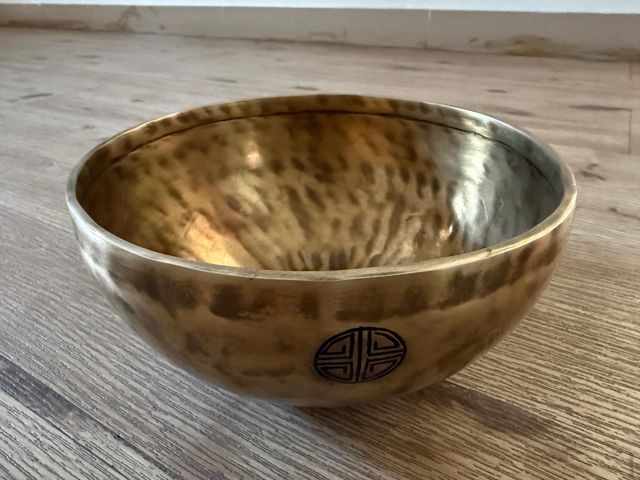
Hand-hammered bronze
Bell-metal bronze, roughly four parts copper to one part tin, the same family of metal as temple bells and gongs. It rings long and rich, with many layered overtones.
Naadova / The singing bowl
Where these bowls really come from, how they are made, why their sound calms the body, and how to play one, told honestly by Ancient Yoga Academy and Prashant Patel.
What it is
A singing bowl is a standing bell. Strike it and it rings; rub a mallet around the rim and it sings with one continuous tone. Most people hear two things at once: a deep tone, and a slow, gentle pulse inside it called beating, which comes from tones that are almost, but not quite, the same.
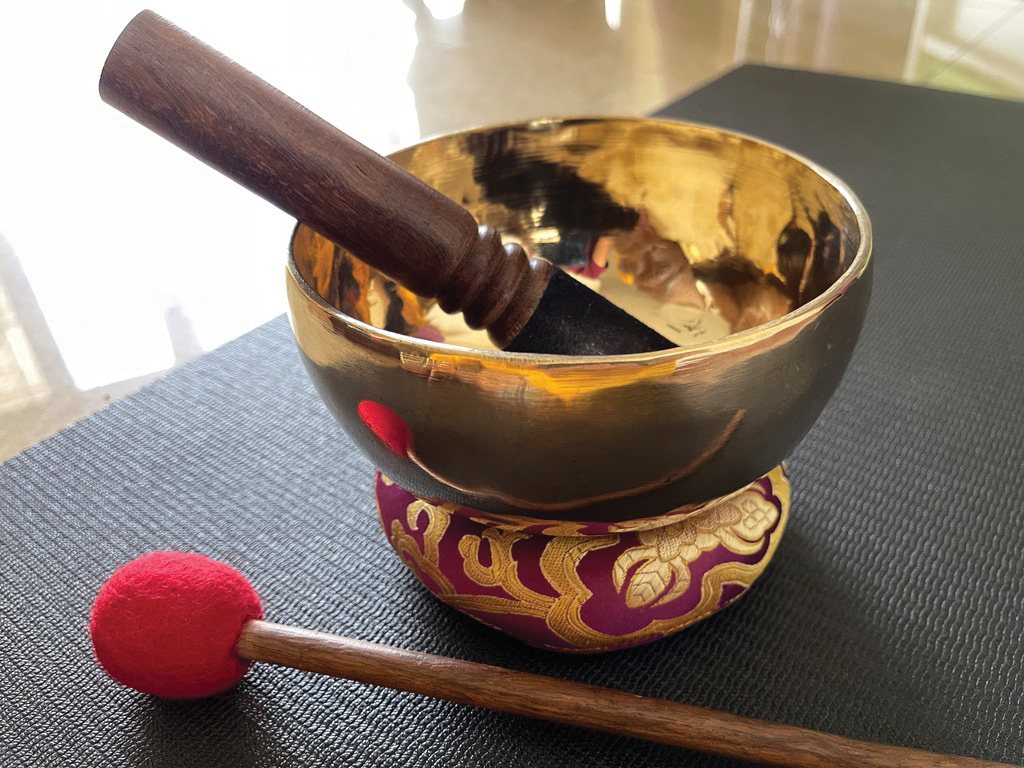
Select a number on the photo to see each part.
The top edge. Rubbing a mallet around the rim makes the bowl “sing”: a continuous tone that grows as you keep moving.
Origins, honestly told
You will read online that singing bowls are thousands of years old and came from secret Tibetan rites. The real story is less mysterious and more interesting. AYA marks what is documented, what is tradition, and what is modern.
Bronze working spreads from the Indus Valley to China. Bronze bowls are made for food, offerings and storage long before anyone plays them for sound.
Bowl-shaped bronze bells that rest on their base, called nao, are among China's earliest metal instruments. Standing bells are believed to have originated in China.
In Chinese and Japanese temples, standing bells (qing, rin, kin or dobachi) are struck to mark chanting and meditation. They are still used this way today.
Metalsmiths in Nepal and northern India hammer bowls from bell-metal bronze for daily and ritual use. This craft is the root of the bowls made today.
The Hatha Yoga Pradīpikā teaches nādānusandhāna, attention to inner sound, as a path to stillness. This is the yoga lineage AYA teaches the bowl within.
Popular stories say lamas used singing bowls in hidden healing rites for thousands of years. Historical accounts of Tibetan music do not mention singing bowls, so AYA shares these as stories, not history.
The album Tibetan Bells by Henry Wolff and Nancy Hennings is the first written record of these bowls as sound instruments. Bowls that “sing” begin to reach the West from the early 1970s.
Demand grows quickly. Many bowls sold as “Tibetan” are made in Nepal and northern India, and playing the rim to make the bowl sing becomes the signature technique.
Quartz crystal bowls, a much newer invention, bring a pure, bright tone to the modern sound bath.
A peer-reviewed study of 62 people finds less tension, anger, fatigue and low mood after a singing bowl sound meditation. It is an early, uncontrolled study, and more research is under way.
Ancient Yoga Academy teaches the bowl as an assessed skill inside yoga therapy, with safety screening and the evidence kept honest. Prashant Patel first taught Level 1 about fifteen years ago; now it fills within days.
The yoga connection
Long before anyone called a bowl a singing bowl, yoga taught that sound can lead the mind to stillness. Nāda Yoga, the yoga of sound, works with Om, with mantra and with nādānusandhāna, listening to inner sound, which the Hatha Yoga Pradīpikā describes in detail.
This is why AYA teaches the bowl inside yoga therapy rather than as a performance. The bowl gives the mind one simple thing to follow; the breath slows; the body moves from alert into rest and repair. The practitioner's job is not to play music but to listen, to the bowl and to the person.
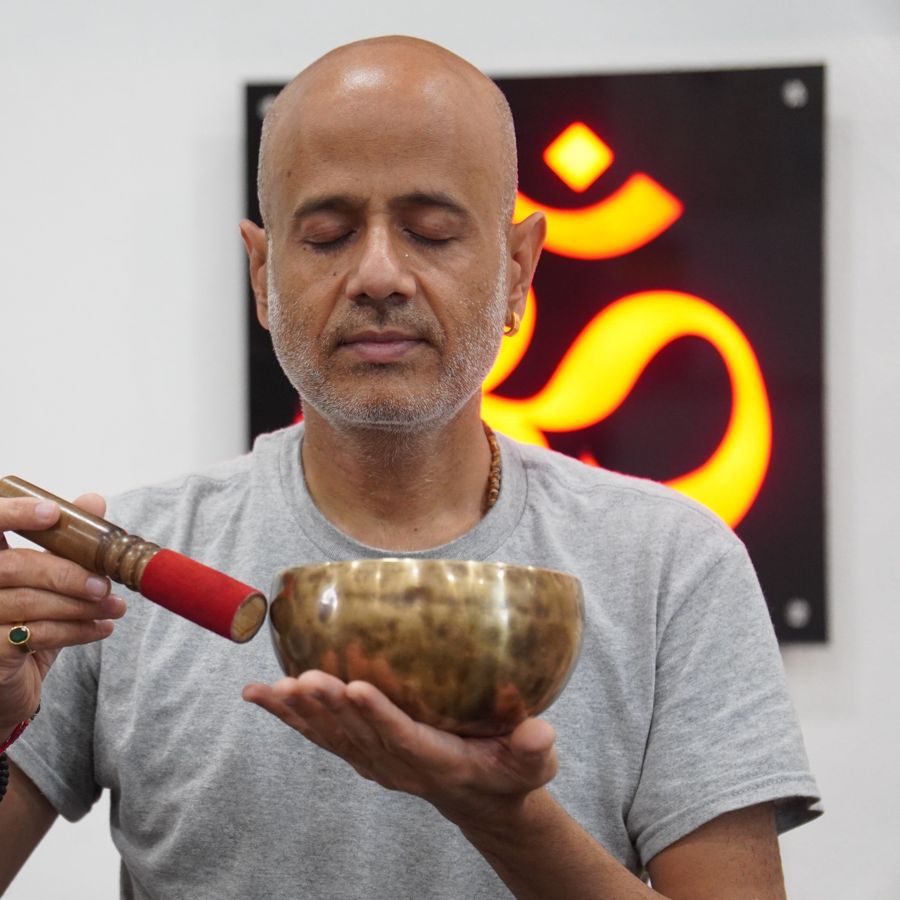
“You don't need language. You don't need movement. You just need to understand the body, understand the vibration, and give. The bowl does the rest.”
How bowls are made
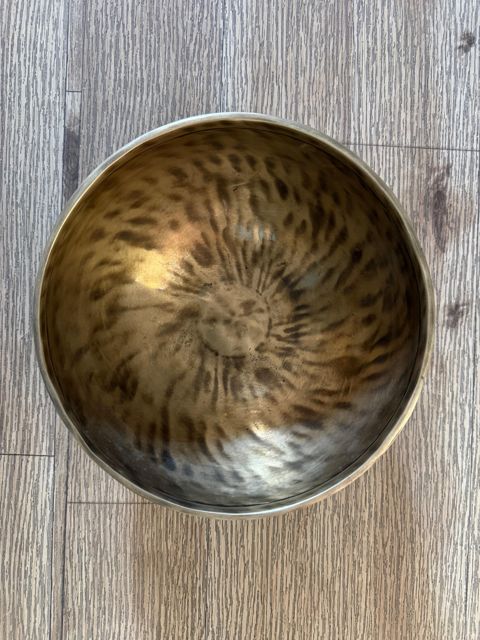
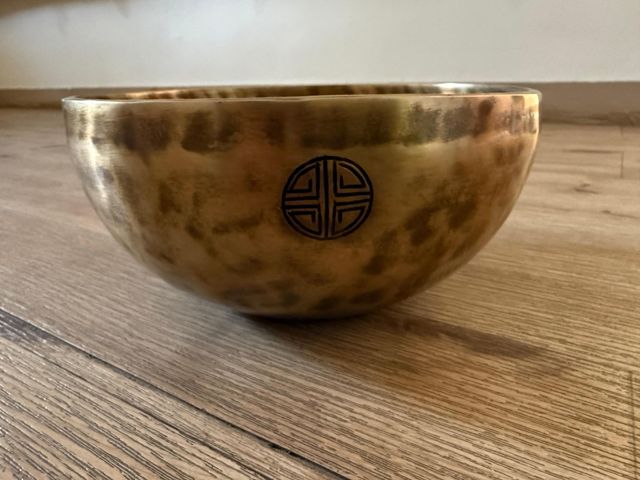
A good bowl is hammered by hand from hot bell-metal bronze, often by a team working in rhythm, then shaped, tuned by ear and finished. Two bowls from the same workshop on the same day never sound the same.
Bell-metal bronze, roughly four parts copper to one part tin, the same family of metal as temple bells and gongs. It rings long and rich, with many layered overtones.
Spun or cast from brass (copper and zinc). Cheaper and more even, but usually duller, with a shorter sustain. Fine for decoration, rarely for healing work.
Tradition links seven metals to seven planets, from gold for the Sun to lead for Saturn. AYA honours the story and teaches it as symbolism, because laboratory tests find bronze.
| Statement | Status | How AYA teaches it |
|---|---|---|
| Bowls are made of seven metals | Tradition | As a story and a set of qualities, not a fact about the alloy |
| Good bowls are bell-metal bronze | Evidence | As fact, supported by laboratory analysis |
| Each metal heals a specific organ | Belief | As a traditional association only |
| Hand-hammered bronze sounds richer than machine brass | Evidence | Demonstrated side by side in class |
Every AYA bowl comes with a sound passport: its note and sustain are measured, and you approve a strike video of your actual bowl before it ships. Visit the Bowl House.
Types of bowls
Press play on each one. These are short synthesised previews; the shop has strike videos of real bowls.
The classic bell-metal bowl, rich in layered overtones. The best first bowl for most people.
See in the shopTraditionally hammered on full-moon nights. Warm, slow beating and a long sustain.
See in the shopSeven bowls tuned close to a scale, from root to crown, used in AYA chakra protocols.
See in the shopA deep bowl for the floor, the abdomen or the feet. Felt in the whole body.
See in the shopQuartz, not metal. A pure, bright tone that carries across a room in a sound bath.
See in the shopHow to play
Three short lessons with Prashant Patel: a small beginner bowl, a large master healing bowl, and a chakra moon bowl.
Why it calms
A long, steady tone gives the mind one thing to follow, and the breath slows. Slow breathing signals safety to the nervous system, and the body shifts from alert into rest and repair. When a bowl rests on or near the body, the vibration is also felt, which many people describe as a gentle inner massage.
Research on singing bowls is still young. In a 2017 peer-reviewed observational study, 62 people reported significantly less tension, anger, fatigue and low mood after a one-hour singing bowl sound meditation, with the biggest drop in tension among first-timers. There was no comparison group, so larger controlled studies are still needed.
Sound healing supports relaxation and wellbeing. It is not a medical treatment and works alongside care from your doctor.
Myths and facts
Turn each card to see what AYA teaches.
Learn with AYA
Ancient Yoga Academy has taught singing bowl healing for about fifteen years, in Singapore, India and Australia, under Prashant Patel. These are the things we hold ourselves to.
Every AYA course says clearly what is tradition and what research shows, so graduates can talk with clients, doctors and organisations with confidence.
Level 1 ends with a theory quiz, a practical video reviewed by a teacher, a practice log and three case studies. A certificate means the skill was checked.
Screening for pacemakers, pregnancy, epilepsy, recent surgery and sensitive hearing is part of every protocol, from the first level.
Led by Prashant Patel, M.A. (Yoga), C-IAYT, E-RYT 500. AYA is an IAYT Member School and APD provider, a Yoga Alliance school (236490) and YACEP provider, and an S-VYASA affiliated centre.
Singing Bowl Essentials, then Level 1 Certified Practitioner, Level 2 Sound Bath Teacher and Level 3 Sound Therapist, with single modules as continuing education.
Every AYA bowl has a sound passport, with its note and sustain measured, and you approve a strike video of your actual bowl before it ships.
Questions
Bowl-shaped bronze bells have a long history across Asia, from China and Japan to the Himalaya. The singing bowls sold today are mostly hand-hammered in Nepal and northern India. Playing them as “singing bowls” for meditation and sound healing became widespread from the 1970s.
Some antique bowls are Tibetan, but many bowls sold as Tibetan are made in Nepal and northern India. Historical accounts of Tibetan music do not mention singing bowls, so “Tibetan singing bowl” is best understood as a modern name.
Good bowls are bell-metal bronze, an alloy of copper and tin. The seven-metal story is a tradition AYA respects but does not present as fact. Cheaper machine-made bowls are often brass and fade sooner.
Many people feel calmer within minutes, as a long steady tone slows the breath. Early research, such as a 2017 study of 62 people, found less tension and better mood after a sound meditation. Research is still young, and sound healing supports, never replaces, medical care.
Rest the bowl on a flat, open palm or a cushion. Strike the outer wall softly with a padded mallet, then press the mallet against the rim and circle slowly to make it sing. The videos above show both, step by step.
Start with Singing Bowl Essentials, 3.5 hours on demand, or go straight to Level 1 Certified Practitioner with Ancient Yoga Academy. Both are taught by Prashant Patel.